

Kilmar
They came for someone. They left with him. Based on a true story.

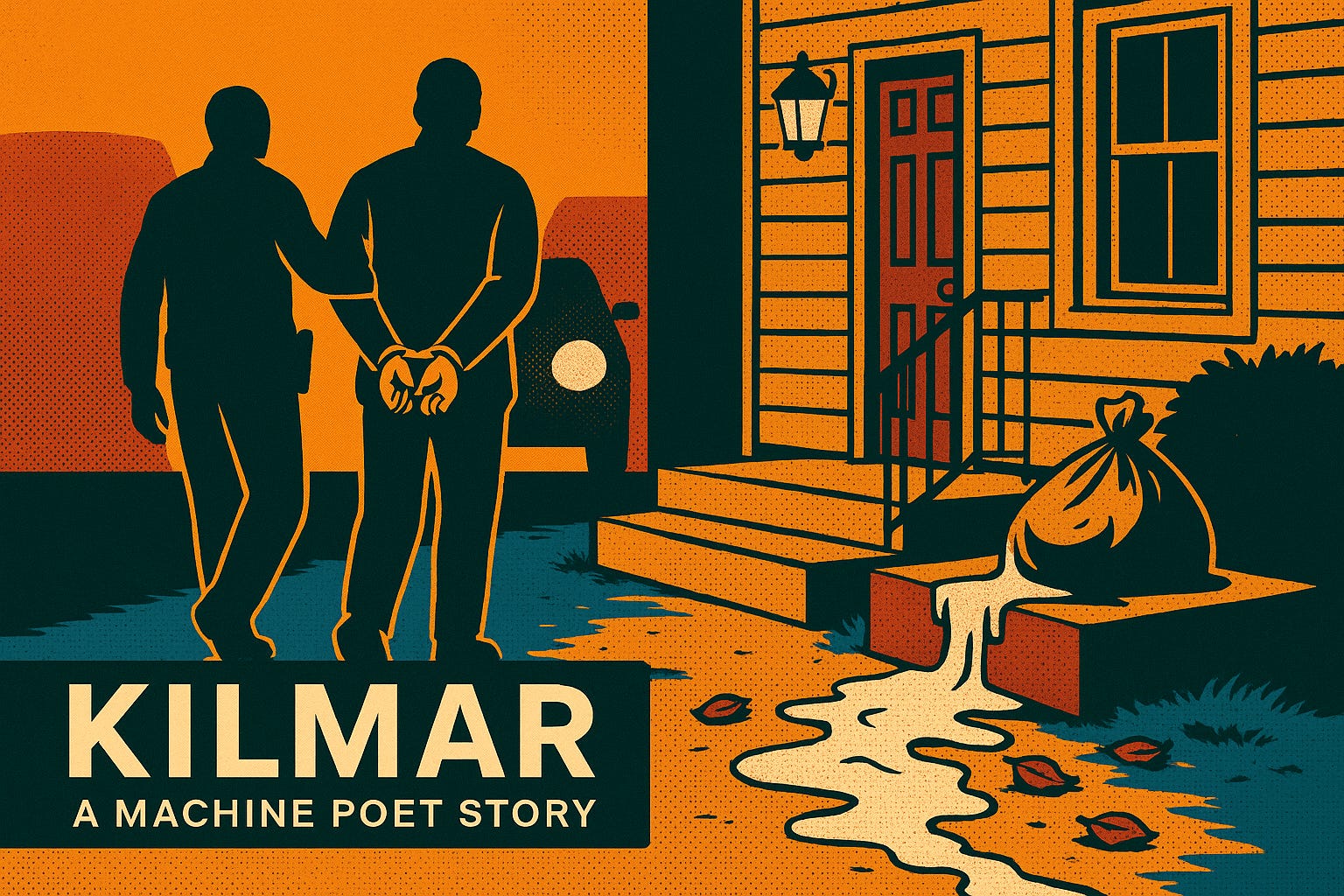
THE DAY THEY CAME
The trash bag was leaking milk down my wrist.
Warm. Sticky. I didn’t feel it at first.
It was a Saturday.
One of the quiet ones.
My wife inside folding clothes.
My twins arguing over cartoons.
My oldest sitting on the porch, her mother's cracked phone in hand, kicking the rail.
The air smelled like grilled meat and dust.
Somebody’s radio down the street blasting old cumbia.
Normal.
Stupidly normal.
Until the engines.
Low. Slow. Heavy.
Two black SUVs turned the corner like they owned it.
I didn’t move.
Some part of me, old and buried, remembered how not to move.
Three men got out.
No uniforms.
Didn’t need ‘em.
One pointed at me.
I tried to say something.
Anything.
Papers. Family. House.
The words stuck in my throat.
The zip ties bit down before I could lift my hands.
I heard the screen door fly open behind me.
My wife —
"¡Suéltenlo! ¡Tiene papeles! ¡Él es ciudadano!"
Her voice tore the air like claws.
They were already pushing me forward.
The trash bag split open across the sidewalk.
Milk and onion skins and old bones spilling out at my feet.
I twisted around.
Caught my daughter’s face, barefoot, screaming.
"¡Papá! ¡Papá!"
Her fists hammered the doorframe.
The screen bouncing with every hit.
They shoved me into the SUV.
The seatbelt scraping my arm.
The door slamming.
The porch light stayed on.
Flickering like it could stop all of it.
I asked where they were taking me.
No answer.
I closed my eyes and whispered:
"No me quiten todo. No, por favor, no todo..."
The engine drowned me.
WHEN I WAS FIFTEEN
El Salvador was a body you lived inside and learned to fear.
Our house was close to the lot behind the school. You could hear the soccer balls smacking the dirt.
After Miguel disappeared, the games stopped.
No funeral.
No searching.
Just a new silence you couldn’t argue with.
The old woman on the corner stopped selling tamales.
The kids stopped riding bikes after dark.
The men on the corner wore their tattoos like warnings.
The night they came to our door, it wasn’t violence.
It was certainty.
Hushed words whispered through the screen:
"Si te vemos aquí otra vez, te matamos."
If we see you again, we kill you.
No second chances.
No mercy.
My mother packed in silence.
A plastic bag.
Two shirts.
My cracked sneakers.
A photo of me at six years old, holding a paper kite.
"Cuídate. Corre."
No tears.
No hugs.
Just her back turned to me as I walked out the door.
I didn’t look back.
You don’t look at the things you can’t carry.
MARYLAND
Winter taught me about pain.
Not the kind you scream about.
The slow, deep kind that stays in your bones.
I learned to keep moving even when my hands went numb.
I learned the smell of bleach and fryer grease.
I learned the sound of pallets slamming against warehouse floors at 2 a.m.
I learned how to say "Good" when someone asked "How are you?"
even if my back was splitting open under two jobs and no sleep.
I met Maria at a restaurant job.
She dropped a tray on my foot and called me "slow" and smiled when she said it.
I loved her before I knew it.
We built a family.
Three kids.
One who didn’t talk until he was four.
One who screamed when the lights were too bright.
Didn’t matter.
They were mine.
Saturdays for Walmart.
Sundays for carne asada if the weather was good.
Mondays for dragging the trash to the curb.
The court finally said it:
Protected.I hung the letter above the kitchen table.
I let myself believe.
Maybe the running was over.
Maybe the fight was done.
DETENTION
The first thing they took was my name.
A number.
A file.
A man in a gray shirt waved me forward without looking up.
Strip.
Cough.
Bend over.
The floor was ice against my feet.
The metal bench smelled like piss.
My mouth tasted like metal.
The lights buzzed like mosquitoes.
They herded us into holding pens.
Metal benches bolted to the floor.
No clocks.
No windows.
The guards joked with each other.
One of them spilled a cup of coffee near my feet.
It steamed into the cold.
No one cleaned it.
When I showed them the papers,
the judge’s order, the court’s seal,
the man behind the counter barely glanced.
"Pending."
Stamped like stepping on an ant.
No lawyer.
No phone call.
No chance.
Just cold metal and long waiting.
A man two benches over puked onto his shoes.
We all just shifted away.
By the time they chained my wrists and ankles,
I already knew.
They weren’t taking me to court.
They were making me disappear.
THE PLANE
The cuffs stayed on the whole flight.
They put us in rows.
Some men prayed out loud.
Whispered, "Dios mío, ayúdame," bleeding through cracked lips.
Some stared blank.
Some twitched.
One man whispered numbers under his breath.
Maybe a phone number.
Maybe something else he didn’t want to forget.
The chains rattled when we shifted.
It was the only real sound.
The air was thick.
Sweat, fear, exhaustion.
I pressed my forehead against the cold window and watched the clouds roll under us.
I told myself:
Maybe the judge will call.
Maybe the guards will realize.
Maybe they'll see Maria's messages.
I closed my eyes.
"Señor, no me dejes morir olvidado."
Don’t let me die forgotten.
CECOT
The prison swallowed the sky.
Concrete walls taller than memory.
The guards didn’t shout orders.
They just pushed.
We were processed like animals.
Shaved heads, stripped naked, sprayed with freezing water.
They gave me a number sewn into a shirt.
Too small.
No shoes.
Twenty men packed into a space the size of a bedroom.
One bucket.
No mattress.
You learned fast:
Don’t talk.
Don’t look.
Don’t cry.
The ones who cried didn’t last long.
Meals came cold, late, or not at all.
I saw men pull pieces of bread out the drain.
I saw a boy not older than sixteen disappear after a guard pulled him from the line.
You didn’t ask questions.
You counted your ribs and tried to remember who you used to be.
At night, in the darkness thick enough to choke:
"No me olvides.
No me olvides.
No me olvides."
But the silence was too full to listen
WHAT I REMEMBER
I remember:
Maria folding clothes in the living room, singing under her breath.
The twins fighting over the good cartoon channel.
My oldest kicking the porch rail with her bare heel.
The smell of beans and grilled chicken in the street.
My daughter’s fists hammering the door.
The sound her voice made when she called for me.
The trash splitting open, everything we had spilling out.
The porch light flickering.
Still burning.
Still waiting.
Even if nobody comes back.
I used to think if I could just make it back to that porch,
everything would go back to the way it was.
But the porch light doesn’t know.
It doesn’t remember.
It just burns.
Quiet.
Faithful.
Stupid.
Alone.
Like me.



🥺❤️
Terrifying.. My neighbors hiding, fruiterias left abandoned in the wake of ice. We lived through a pandemic now its time to live through a Civil War or worse, a world where we all rollover or simply look away. I really hate it here.